
1. The Great Distraction
In the corridors of high finance, the air is thick with a singular, hyper-focused anxiety: the “quarter-point obsession.” Markets and analysts remain locked in a perpetual vigil, parsing every syllable from “Warsh & Co.” to determine if the Federal Reserve will nudge interest rates up by 25 basis points. It is a masterclass in budgetary theater, a spectacle of precision that suggests we are still in control of the macroeconomic lever.
However, this fixation on the minutiae of monetary policy is nothing more than fiscal smoke and mirrors. While the public parses Fed transcripts, the Trump administration continues its unabated march toward insolvency, adding relentlessly to a mountain of debt that has now hit a staggering $40 trillion. We are engaged in a heated debate over the speed of the vehicle while ignoring the fact that the car is hurtling toward a concrete wall.
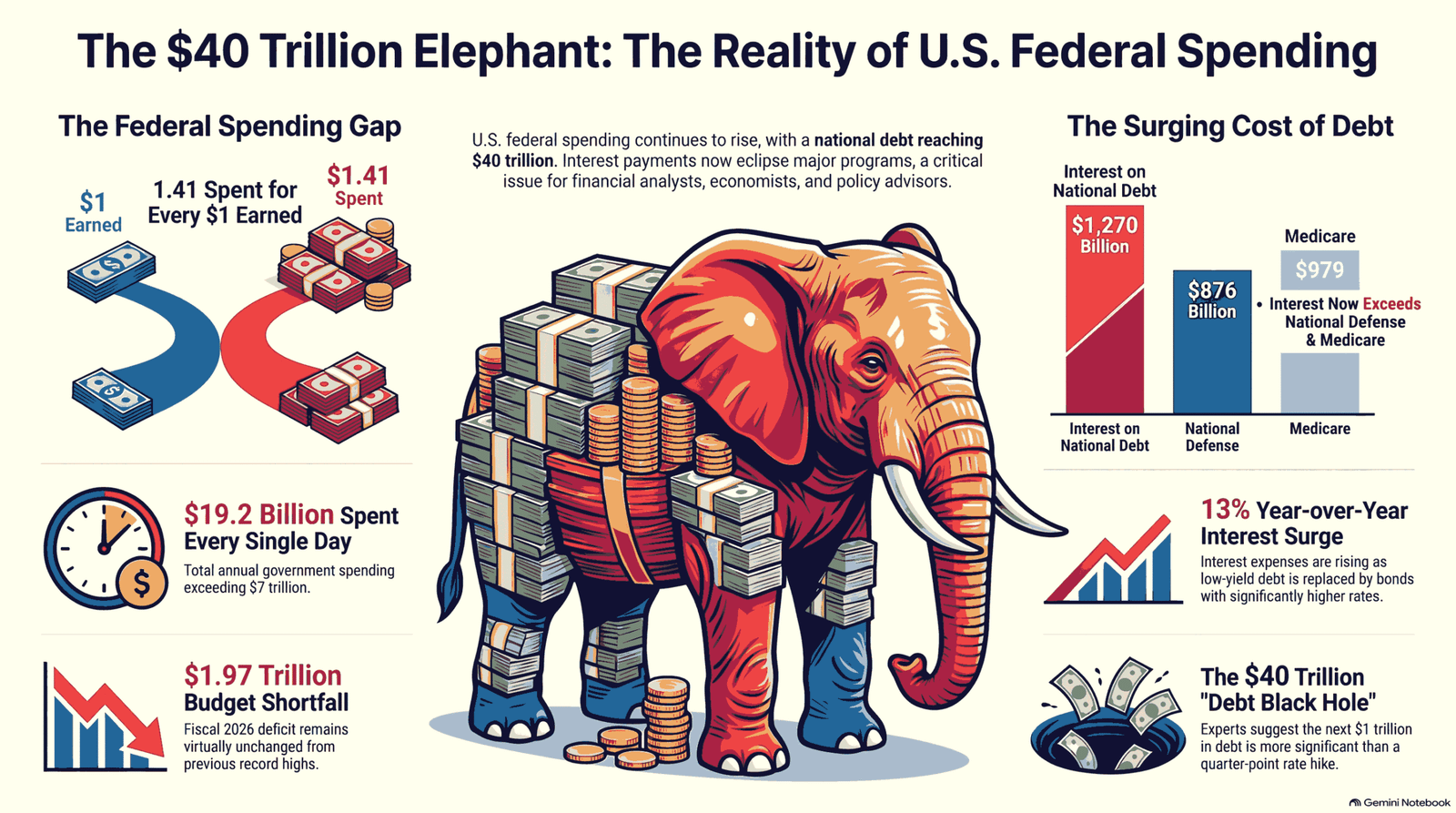
As the data makes clear, the market’s fixation is misplaced. Quite frankly, the next $1 trillion in debt is almost certainly more significant to the long-term health of the Republic than a mere quarter-point hike in rates. This “elephant in the room” is not a future theoretical risk; it is a present-day systemic crisis that no amount of interest rate fine-tuning can resolve.
2. The Illusion of the “Shrinking” Deficit
Mainstream reporting on the August 2026 fiscal data provided a masterclass in accounting obfuscation. Many outlets breathlessly reported a “shrinking” deficit, pointing to the official $166.8 billion shortfall as a sign of newfound restraint. They were aided by a temporary revenue boost from the administration’s trade policy, as the Treasury enjoyed $12.84 billion in net tariff receipts while refunds plummeted to $10.54 billion from July’s $33.38 billion.
The reality, however, is a product of calendar shifts and clever timing. Because billions in Social Security and Medicare payments were pushed back into July, the August outlays were artificially suppressed. When you strip away these maneuvers and the tariff-driven revenue blips, the “real” adjusted deficit for August rises to $248 billion—actually $7 billion higher than the same period last year.
“When people say the spending is unsustainable, it feels like an understatement. In fact, it’s fair to call the federal government insolvent.”
3. The 1.41 Ratio: Running a Nation on Borrowed Time
To understand the depth of this “Debt Black Hole,” one must look at the toxic relationship between what the Trump administration earns and what it spends. Through the first 11 months of fiscal year 2026, total federal receipts stood at $4.85 trillion. During that same period, outlays reached a massive $6.81 trillion.
The synthesis is sobering: for every $1 the federal government receives in revenue, it spends $1.41. This means that 28.9% of all federal outlays are currently funded by borrowed money. This is a self-perpetuating cycle where the interest on previous debt requires even more debt just to keep the lights on—a trajectory that interest rate tweaks are fundamentally powerless to alter.
4. $19.2 Billion Every Single Day
The sheer scale of federal outlays is often lost in a sea of “trillions.” When we humanize the burn rate, the “Big Picture” becomes alarmingly clear. Despite the media hype surrounding the Department of Government Efficiency (DOGE) and the “Big Beautiful Bill,” the actual spending trajectory is moving upward, not down. While there have been high-profile cuts to the EPA, the Department of Education, and federal staffing, these are mere drops in a bucket that is being filled faster than it can be drained.
- The Monthly Average: $583.3 billion.
- The Daily Burn Rate: $19.2 billion.
The hard truth is that the U.S. government blew through just over $7 trillion last year. With the added pressure of active warfare and a lack of genuine political commitment to tackle runaway outlays, the “savings” reported in small agency budgets are being entirely overwhelmed by the broader tide of federal expansion.
5. The Tipping Point: Interest vs. The Pentagon
Perhaps the most alarming takeaway from the recent Treasury data is that the cost of simply servicing our past has become more expensive than protecting our future. Gross interest expense has officially become a larger line item than the most foundational functions of the state.
The Fiscal Hierarchy (FY ’26 to date):
- Social Security: $1.5 trillion
- Gross Interest Expense: $1.27 trillion
- Medicare Outlays: $979 billion
- National Defense: $876 billion
Interest is now the second-largest line item in the entire U.S. budget. This is a monthly compounding disaster driven by the “maturing paper” problem. For years, the Treasury financed its debt at near-zero rates. Now, as that low-yielding paper matures every single month, it must be replaced by new bonds yielding significantly higher rates. We are effectively refinancing a sub-3% mortgage into a 5% environment at a scale of trillions of dollars per month.
6. The “One-and-Done” Prediction
The collision between an ever-growing debt burden and rising interest rates has created a state of “fiscal dominance,” where the Treasury’s needs effectively hijack monetary policy. This reality suggests that the Federal Reserve’s hands are not just tied—they are handcuffed. While the markets expect a cycle of hikes, the Debt Black Hole makes such a path a recipe for immediate systemic failure.
If the Fed proceeds with a move, it will likely be a “one-and-done” maneuver. More hikes would essentially bankrupt the Treasury by exploding the interest servicing costs beyond the point of no return. The political class continues to find new reasons to spend—ignoring the fact that the cost of borrowing is now eating the budget from the inside out.
7. Conclusion: The Problem That Tackles You
The road ahead is paved with best-case scenarios that rarely manifest. CBO forecasts project that net outlays will rise to $8.151 trillion by 2028. This forecast does not fully account for the inflationary pressures of war, which drive energy prices higher and force the Fed to keep rates elevated, further worsening the debt servicing spiral.
The political class continues to treat the debt as a secondary concern, a problem to be “managed” through central bank mechanizations. But eventually, the math stops asking questions and starts demanding payment. We must ask ourselves: what happens to a nation when the math finally “tackles” the political class, rather than the other way around?
Comments are closed