
1. INTRODUCTION: THE UNIMAGINABLE NEW NORMAL
In the span of a single decade, gold has staged a relentless climb from $1,500 to over $4,000 an ounce, shattering what many once considered the “ceiling” of possibility. Yet, as the headlines scream about the next “magic number”—be it $8,000, $10,000, or $12,000—the retail crowd is missing the forest for the trees. For the sophisticated allocator, these price targets are mere noise. The strategic reality is far more sobering: gold isn’t just rising; it is responding to a structural rot in the global credit system.
The “relatable problem” for today’s investor is a fixated obsession with price levels while ignoring the momentum of the train we are all riding. As we move from an era of stability into a high-velocity debt spiral, gold has transitioned from a speculative luxury to a barometer of systemic trust. We aren’t just watching a bull market; we are watching a countdown.
2. TAKEAWAY 1: IGNORE THE PRICE TARGET—WATCH THE DEBT CLOCK
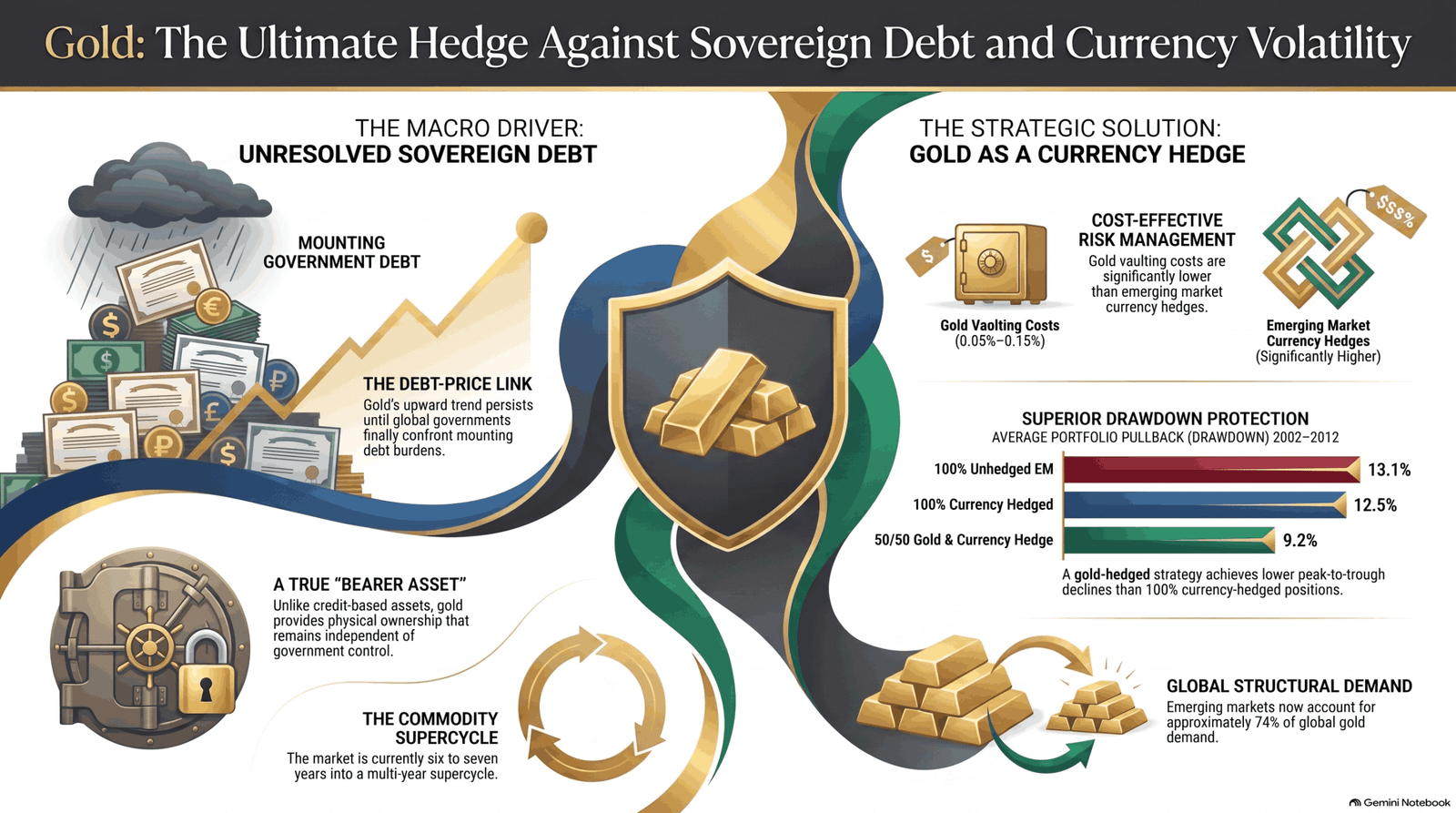
John LaForge, Chief Alternative Strategist at Ned Davis Research, identifies a truth that most analysts are too timid to voice: gold’s price is essentially a tethered shadow of sovereign insolvency. When investors ask “how high can it go?”, they are asking the wrong question. The real question is: “When will the debt stop growing?”
“I think prices peak when we learn how to deal with the debt situation. The longer we let it go and we don’t pay this stuff back and we keep piling all these debts up, the higher gold prices can go.” — John LaForge
Analysis: With U.S. sovereign debt now pushed beyond the $40 trillion mark, the math of “repayment” has entered the realm of fiction. There is no politically survivable path toward the fiscal discipline required to settle these obligations in real terms. Instead, currency debasement—inflating the debt away—is the only exit strategy politicians can stomach. For the investor, this means gold’s upward trend isn’t a “bubble”; it is the natural inverse of a depreciating fiat ledger.
3. TAKEAWAY 2: THE RISE OF THE “BEARER ASSET” REVOLUTION
The 2022 invasion of Ukraine marked the end of the “neutral reserve” era. When Western powers froze Russian foreign reserves, they sent a clear message to every central bank on earth: any asset held within the global credit system is a liability of the state that controls the ledger. This realization has triggered a sovereign rush into “bearer assets”—wealth that exists outside of anyone else’s control.
- Assets Held Within the Credit System: Vulnerable to political sanctions, freezing, or seizure; dependent entirely on the solvency and goodwill of the issuing nation.
- Physical Gold: A globally recognized payment asset; requires no counterparty; can be held in-hand, outside of foreign jurisdictions, with value recognized in every corner of the globe.
Analysis: This is more than a shift in sentiment; it is a massive re-allocation of global power. While Western developed markets hold roughly 22% of their reserves in gold, emerging market (EM) central banks have historically held only about 4.6%. The strategic necessity to close this gap—moving away from “sanctionable” paper toward physical bars—represents a multi-year floor of structural demand that the market has only begun to price in.
4. TAKEAWAY 3: THE 6% “HIDDEN TAX” ON INTERNATIONAL INVESTING
Investors seeking growth in emerging markets often find their gains evaporated by the “hedging drag.” While specific numbers fluctuate, the structural cost of protecting against currency volatility remains a constant. Historical precedent from the World Gold Council shows that as far back as 2012, hedging the Indian Rupee cost 5% annually; across a broader EM basket, that “tax” averaged nearly 6%.
Gold acts as a superior “proxy hedge,” allowing investors to capture EM growth without the ruinous carry costs of traditional currency contracts. Gold works as a hedge for three structural reasons:
- Correlation to EM Growth: Gold demand rises as disposable income grows in China and India (jewelry and technology).
- Negative Correlation to the USD: Gold typically appreciates when the dollar weakens, protecting against USD-based volatility.
- Low Carry Cost: Vaulting physical gold (5–15 bps) or owning an ETF (15–50 bps) is a fraction of the 5-6% interest-rate differential paid in currency markets.
Analysis: The dilemma of the hedging drag is that traditional protection often wipes out half of an investor’s total return. By using gold as a proxy, the strategist captures the “beta” of emerging markets while avoiding the interest-rate bleed that makes traditional hedging a losing game.
5. TAKEAWAY 4: JAPAN IS THE CANARY IN THE DEBT COAL MINE
Japan has long been the “test case” for whether a nation can suppress borrowing costs indefinitely. For decades, Tokyo used “yield-curve control” to mask the reality of a debt-to-GDP ratio exceeding 200%. But that strategy has reached its limit. As yields rise and the Yen falters, the failure of the Japanese model serves as a grim preview for the rest of the West.
“A lot of the West, we’ve gotta figure out how to deal with our debt the same way. The last thing … the powers that be want is to show that yield curve control won’t work.” — John LaForge
Analysis: Debt is not merely a numerical problem; in Japan, it is a demographic one. A fast-ageing population and a shrinking workforce can no longer support the fiction of suppressed yields. This is why Japanese institutional investors, after “the lost 20 years” of deflation, are finally capitulating and moving into gold. They are recognizing that when the state can no longer control the cost of its debt, the only safety is in an asset the state cannot print.
6. TAKEAWAY 5: WE ARE IN “MID-CYCLE,” NOT A BUBBLE
Despite the record highs, we are nowhere near the “blow-off top” seen in 2011. Data from Ned Davis Research shows that speculative excess is remarkably absent from the current market. Instead, we are likely only six or seven years into a multi-year commodity supercycle.
To navigate this “mid-cycle” environment, a 10% “Alternative Allocation” is the recommended defensive posture:
- 5% Gold: The anchor asset for debt and debasement protection.
- 3% Broad Commodities: Capturing the wider inflationary supercycle.
- 2% Bitcoin: As a digital complement within a diversified alternative basket.
Analysis: History shows that supercycles rarely end before the general public is fully “all-in.” We are currently seeing structural central bank buying, not a retail mania. This suggests that the trend has significant longevity before it reaches exhaustion.
7. CONCLUSION: THE TRAIN IS SPEEDING UP
Gold is not merely a commodity; it is a barometer of trust in a monetary system built on the shifting sands of credit. As global debt levels accelerate, the “train” of the global economy is no longer just moving; it is accelerating toward a point of no return.
As John LaForge vividly describes: “It’s not completely off the tracks yet, but it’s almost like the train has gone from moving 40 miles an hour to 120. We gotta slow this thing down, or we’re not gonna stay on the track.”
The gold bull market will end only when fiscal discipline returns and confidence in the credit system is restored. This leaves the investor with one final, provocative question: If the ultimate end of this cycle requires politicians to prioritize debt repayment over their own re-election, are you betting on gold—or are you betting on a miracle?
Comments are closed