
Introduction: The Unstoppable (But Questionable) Rally
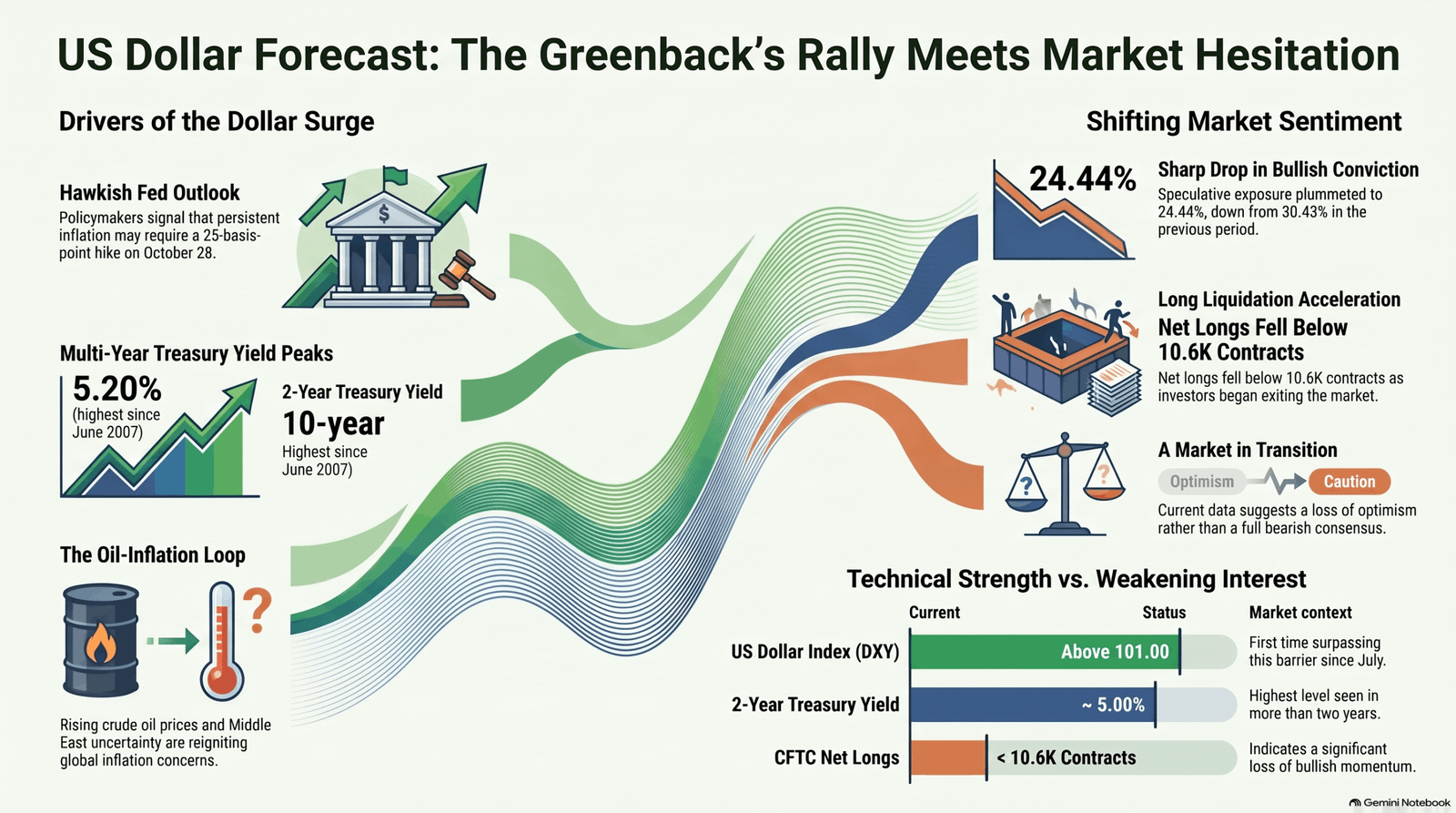
The US Dollar has rediscovered its “mojo.” After reversing two consecutive months of declines, the Greenback has surged to its highest levels in two months, with the US Dollar Index (DXY) finally reclaiming the 101.00 barrier for the first time since the end of July 2026. On the surface, the narrative is one of “US exceptionalism”—buoyed by firm economic activity and a Federal Reserve that refuses to blink in the face of inflation.
However, a look at the market’s underlying plumbing reveals a striking paradox. While the spot price is “ripping” higher, bullish conviction among major professional players is actually evaporating. If the macro data is so resilient and yields are at multi-decade highs, why is the “smart money” heading for the exit? This post distills the four most impactful and counter-intuitive takeaways from the latest market data to explain a rally that may be more fragile than it appears.
Takeaway 1: Yields are Testing Time-Capsule Levels
The primary engine of the Dollar’s resurgence is a violent repricing in the bond market. US Treasury yields have found a second wind, returning to levels that feel like a journey through a time capsule. These milestones are acting as a massive magnet for global capital, reinforcing the Dollar’s appeal as the ultimate “yield play.”
- 2-Year Yields: Approaching the 5.00% mark for the first time in more than two years.
- 10-Year Yields: Advanced to 5.20%, a peak not seen since June 2007.
- 30-Year Yields: Have moved past 5.20%, reaching levels last witnessed in early June 2002.
“The Greenback’s move higher has found extra wings in the sharp uptick in US Treasury yields.”
Takeaway 2: The Great Positioning Divergence
The most surprising revelation in the latest data is the “sharp deterioration” in professional participation. According to CFTC data for the week ending September 15, 2026, the Dollar’s price is rising even as bullish conviction fades. This is a classic “long liquidation” scenario—investors are taking profits and leaving the market rather than doubling down.
The velocity of this shift is notable: the 4-week change in net longs has weakened to just around 8.5K contracts, signaling a clear acceleration in the loss of momentum. The once-dominant speculative advantage has shifted toward neutral territory:
- Net Longs: Fell to just under 10.6K contracts.
- Speculative Exposure: Dropped to 24.44% (down from 30.43%), with the Speculative Exposure Percentile easing to 44.2.
- Net Position Percentile: Eased sharply to 45.2.
With open interest also declining to around 43.8K contracts, the rally is currently lacking the “fresh blood” of new buyers, suggesting it may be struggling against significant overhead resistance.
Takeaway 3: The “Oil-Inflation-Hike” Feedback Loop
A significant catalyst for this surge has been the rebound in crude oil prices, coupled with a persistent stalemate in negotiations regarding the US-Iran-Hormuz conflict. This has created a self-reinforcing cycle that keeps the Fed hawkish: Crude Oil up → Inflation concerns follow → Rate hike bets increase.
Investors are now pricing in approximately 36 basis points of additional tightening by year-end, with a 25-basis-point hike favored for the October 28 meeting. There is a certain irony here: the Dollar’s “exceptionalism” is currently being driven by energy-led inflationary pressure—which acts as a tax on the global economy—rather than pure organic growth or productivity gains.
Takeaway 4: A Tale of Two Hikes (Fed vs. BoJ)
Last week, both the Federal Reserve and the Bank of Japan (BoJ) delivered 25-basis-point rate increases. On paper, they look synchronized; in practice, the market only believes one of them. While the Fed successfully projected a “higher for longer” stance, the BoJ’s move was dismissed as a “dovish hike,” further undermined by intervention fears as USD/JPY neared the 159.00 level.
The Fed’s credibility has been reinforced by a chorus of hawkish officials who insist the September hike was a necessary response to embedded risks:
- Austan Goolsbee (Chicago): Warned that stronger demand would require a “more forceful” policy response.
- Alberto Musalem (St. Louis): Argued for another rate increase, favoring “early, gradual tightening” over delay.
- Policy Consensus: Policymakers warned that supply shocks may not ease quickly and that inflation risks remain embedded in consumer expectations.
Conclusion: A Market in Transition
The US Dollar currently stands at a crossroads. While the macro backdrop—sky-high yields, geopolitical instability, and a resolute Fed—remains supportive, the latest CFTC numbers suggest that speculative “longs” are less convinced of the durable trend.
The coming week will be the ultimate arbiter. The focus shifts to a heavy data docket including the ISM Manufacturing gauge, JOLTS Job Openings, the ADP report, and Nonfarm Payrolls. These prints must confirm that US activity is resilient enough to withstand these “time-capsule” yields.
The central question for Q4 2026 remains: Is this rally the start of a durable new regime, or is it merely the final positioning adjustment of a tired trend before the tide turns? For now, the balance of risks still favors the Greenback, but the professionals heading for the exit suggest the path higher is becoming increasingly narrow.
Comments are closed